Disciplined, in long columns, soldiers descend from the hills of North Kivu and South Kivu in the Democratic Republic of the Congo and head towards the Rwandan border. For months, Kigali had denied deploying troops in eastern Congo to support the M23 rebel movement. Yet images of their departure—under pressure from the United States—are now broadcast without restraint.
They leave behind their Congolese allies, the armed M23 movement and its political wing, the Alliance Fleuve Congo (AFC). Its leader, Corneille Nangaa—a former head of the electoral commission and close to ex-president Joseph Kabila—had vowed a year ago to reach Kinshasa and topple Félix Tshisekedi. The current head of state, who is due to complete his second and final term within two years, appears determined to remain in power by amending the constitution.
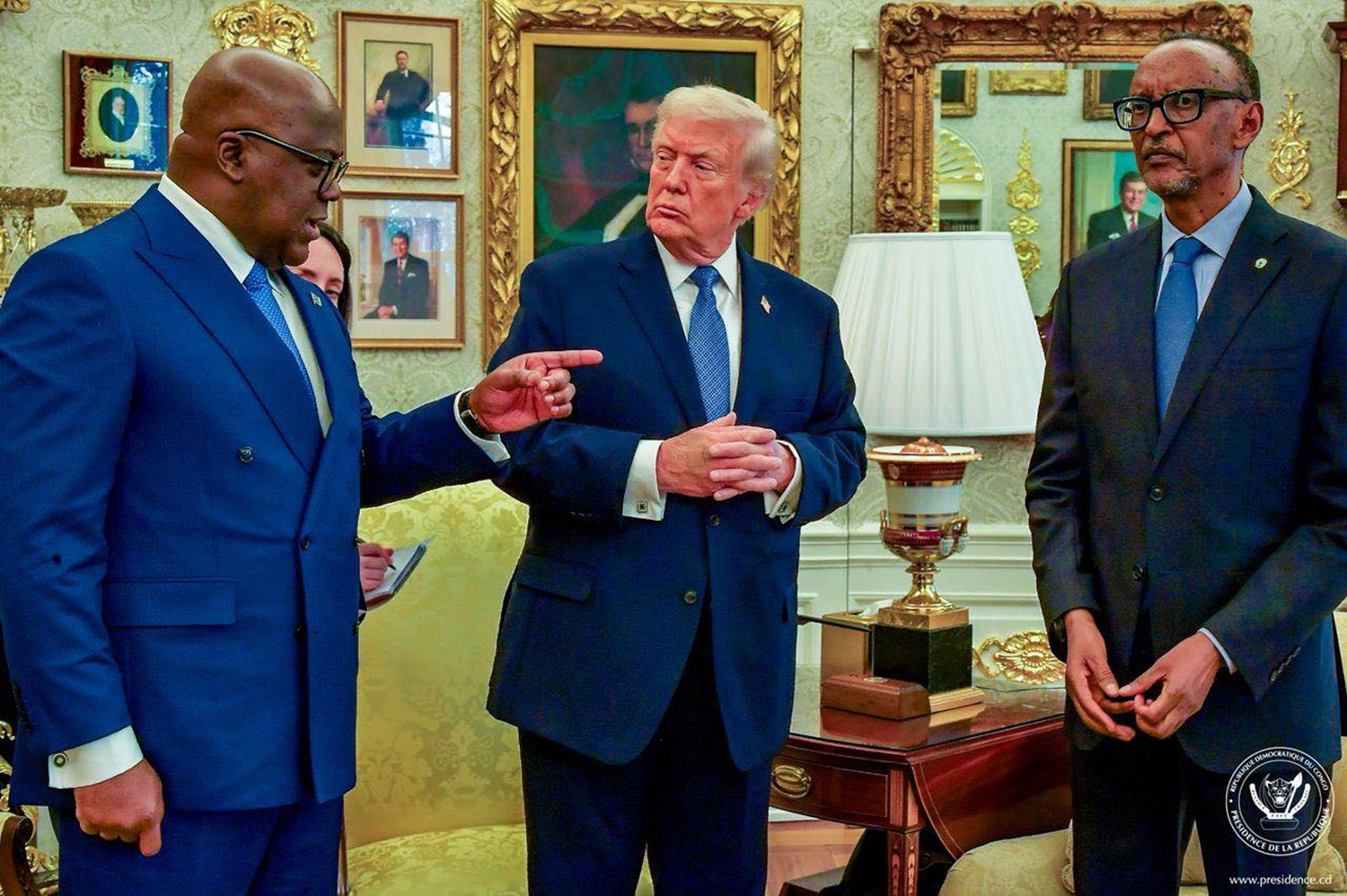
Despite the war in Iran, the United States is intent on enforcing the peace agreement signed in Washington between Rwanda and the DR Congo on 4 December 2025. Swayed by the economic promises of the Congolese president, Washington seeks to impose this “pax americana” on Paul Kagame, who continues to invoke security concerns to justify indirect control over North and South Kivu through rebel proxies.
Jean-Luc Habyarimana: the Akazu’s son in Kinshasa
The security concerns put forward by Kigali are not merely a pretext. Three decades after the genocide of the Tutsi in Rwanda—which claimed nearly one million lives between April and July 1994—survivors and their descendants remain deeply traumatised. Many Rwandan Tutsi, despite the country’s outward calm and the focus on younger generations, fear a renewed offensive by Hutu forces and their politico-military movement, the Democratic Forces for the Liberation of Rwanda (FDLR). The group recruits among descendants of Hutu refugees who fled to DR Congo after the genocide and have retained hopes of revenge.
Moreover, the presence in Kinshasa of Jean-Luc Habyarimana has not gone unnoticed in Kigali. The son of President Juvénal Habyarimana, whose assassination on 6 April 1994 triggered the genocide, is seen as the political heir to the Akazu—the “household”, in Kinyarwanda—referring to the hardline Hutu circle that dominated power before and during the killings. Closely tied to his mother, Agathe Kanziga, who still lives in France, Jean-Luc Habyarimana is a long-standing associate of one of President Félix Tshisekedi’s most influential advisers, Bula Mandungu Bula Nyiati. The latter is the son of Bula Mandungu, once a close confidant of Mobutu Sese Seko. The two men, shaped by their respective family legacies, first met during their exile in Europe after the deaths of Habyarimana and the fall of Mobutu.
The hardening of the Tshisekedi administration’s stance towards Rwanda during his first term—contrasting with earlier conciliatory rhetoric—and his recent election campaign, marked by belligerent discourse, are often attributed to the influence of Bula Mandungu, who also opened DR Congo to Gulf countries after spending a decade there.
Sanctions against Rwanda’s defence forces
Even so, the intransigence displayed by Paul Kagame is not solely driven by security considerations; economic interests are also at play. Keen to rebuild his country, Kagame has sought to channel the flow of raw materials—cobalt, coltan and niobium—from eastern Congo towards Rwanda. Much of these resources, extracted from areas controlled by M23 rebels, are processed in Kigali before being re-exported to industrialised countries, including those of the European Union. Under its “Global Gateway” strategy, the EU signed a strategic partnership with Rwanda on 19 February 2024, aiming to secure sustainable access to critical raw materials while positioning Rwanda as a regional processing hub.
Unable to defeat the M23 rebels and their Rwandan backers on the ground since hostilities resumed in January 2025—and having lost control of North and South Kivu—Félix Tshisekedi turned to Washington for mediation. In return, he offered US companies access to mining operations in Kivu and possibly Katanga, where Chinese investments are already well established. Major tech firms have shown interest, and Massad Boulos, a close ally of Donald Trump, was tasked with preparing the “pax americana”.
Since the December 2025 agreement, US pressure on Kigali has intensified. On 2 March, it translated into measures directly targeting the Rwanda Defence Forces. According to a study published in Brussels by the Egmont Institute, the US Treasury imposed sanctions on four senior Rwandan officers and on the armed forces as a whole. Any entity deriving more than 50% of its revenue from the Rwandan military risks being barred from conducting transactions in dollars or using the Swift international payment system. The measures also affect numerous companies closely tied to the military, potentially disrupting supplies of military and logistical equipment.
The army as guarantor of stability?
Researchers at the Egmont Institute stress the central economic role of the Rwanda Defence Forces, spanning construction, agriculture, finance, arms production, healthcare services and military academies. Meanwhile, the holding company Crystal Ventures, backed by the ruling Rwandan Patriotic Front, operates across several African countries, including the Central African Republic, Mozambique and Zimbabwe. This pervasive military presence has long been viewed as a pillar of Rwanda’s stability.
Historically, it reflects the need to rebuild a country devastated by genocide, which left one million dead and four million refugees abroad—nearly half the population at the time. Under the uncontested leadership of Paul Kagame, the armed forces became the backbone of national reconstruction, often cited as a success despite persistent inequalities and restrictions on fundamental freedoms.
If rigorously enforced, current US sanctions risk undermining this fragile balance from within, as the trauma of genocide remains deeply embedded in collective memory. They could also accelerate the erosion of a regime that has been in power for more than three decades.
Congolese army, foreign mercenaries and “wazalendo” militias
As they witness the withdrawal of Rwandan forces, residents of Kivu remain unconvinced. The M23 movement—initially composed of Tutsi from Kivu who had sought refuge in Uganda—has entrenched itself over the past year, expanding recruitment, training new fighters and establishing administrative structures in an attempt to consolidate de facto authority, albeit without broad popular support.
Nor do the Armed Forces of the Democratic Republic of the Congo inspire confidence. Poorly paid and often undisciplined, they are weakened by corruption. Some elements have collaborated with highly questionable allies, including descendants of those responsible for the Rwandan genocide. Foreign mercenaries, recruited at great expense and equipped with Turkish drones stored in Kisangani, also operate alongside them.
On the front lines are also “wazalendo” militias—“children of the country”—made up of young Congolese. Unemployed workers and students without resources, driven by necessity as much as patriotism, they have joined the fight alongside the national army rather than languish in a country long plundered and invaded.
In such conditions, and in the absence of meaningful democratic accountability, the “cut-price peace” brokered by Washington through pressure on both Rwanda and the DR Congo remains deeply fragile.
Journalists caught in the crossfire
Amid occupation, resource plunder and extortion by armed groups in Kivu, journalists find themselves on the front line. They are quite literally caught between opposing forces, working at great personal risk.
In a detailed report published on 30 March, titled In the Skin of a Great Lakes Journalist, the NGO Reporters Without Borders describes the daily reality of those still known in DR Congo as “knights of the pen”, who now operate under increasingly perilous conditions. Between 2021 and 2026, RSF documented at least 630 abuses against journalists.
Among them is the arrest, on 29 March, of Espoir Kabata, director of a community radio station in Minova, North Kivu. His “crime” was to report on the likely withdrawal of AFC/M23 fighters. His family has had no news of him since.
In Goma, another journalist, Thomas Kubuya, head of VBR-FM, says soldiers stormed his home, seized his car keys and accused him of opposing the AFC/M23. He claims his family is in danger and that those who took his vehicle were linked to the rebel-installed provincial administration.
Veteran journalist Nicaise Ki Bel Om Bel—who first documented the arrival of ADF Nalu rebels in Ituri—was forced to flee from Bunia to Goma and then to Kinshasa. He says he knows too much to remain safely in eastern Congo.
Evoking the painful memory of Rwanda’s Radio Mille Collines, RSF notes that “in this Great Lakes region, plagued by instability and armed conflict, informing remains a daily challenge amid insecurity, economic hardship and disinformation”.
Across DR Congo, Rwanda and Burundi, journalists face similar threats: death threats, disappearances, restricted access. Burundian journalist Antoine Kaburahe, founder of the media outlet Iwacu, points to the “instrumentalisation of violent memory”—whether of massacres in Burundi, the genocide in Rwanda or wars in eastern Congo. In such contexts, any criticism is framed as destabilisation and criminalised in the name of national security.
This weakening of media coverage—partly due to the threats facing local journalists—does more than reduce international attention and aid. It obscures realities on the ground from global powers and potential investors, masking the complexity of political dynamics, the depth of trauma and the aspirations of local populations. Ignorance of these realities also leads some investors to overlook the risks of further tragedies in the making.
