On 25 April, at dawn, Mali was hit by a coordinated attack of unprecedented scale: at least six localities, including the capital Bamako, were targeted by two insurgent groups, Jama’at Nusrat al-Islam wal-Muslimin (JNIM) and the Front de libération de l’Azawad (FLA).
Kati, the garrison town north of Bamako and seat of power of the Malian military junta led by General Assimi Goïta, who has ruled the country with an iron fist since the coup of 24 May 2021, was targeted, as was the private residence of Defence Minister General Sadio Camara, one of the architects of Mali’s rapprochement with Russia. The senior officer succumbed to his injuries, along with several members of his family, in the same car bomb attack.
The northern city of Kidal, a historic stronghold of separatist rebels, has meanwhile fallen into insurgent hands. It had been recaptured in 2023 by the Malian army with the support of the Russian paramilitary company Wagner, later replaced by Africa Corps after the death of Yevgeny Prigozhin.
Since then, the authorities in Bamako have been under pressure. Speaking to AFP on 29 April in Paris, Mohamed Elmaouloud Ramadane, spokesperson for the FLA, stated that “the regime will fall sooner or later.” The objectives of the groups are clear: to take the cities of Gao, Timbuktu and Menaka and, above all, to force the Russians out. “Our problem is political,” he said, adding that “[we] viewed the Russian intervention in support of the junta very negatively.”
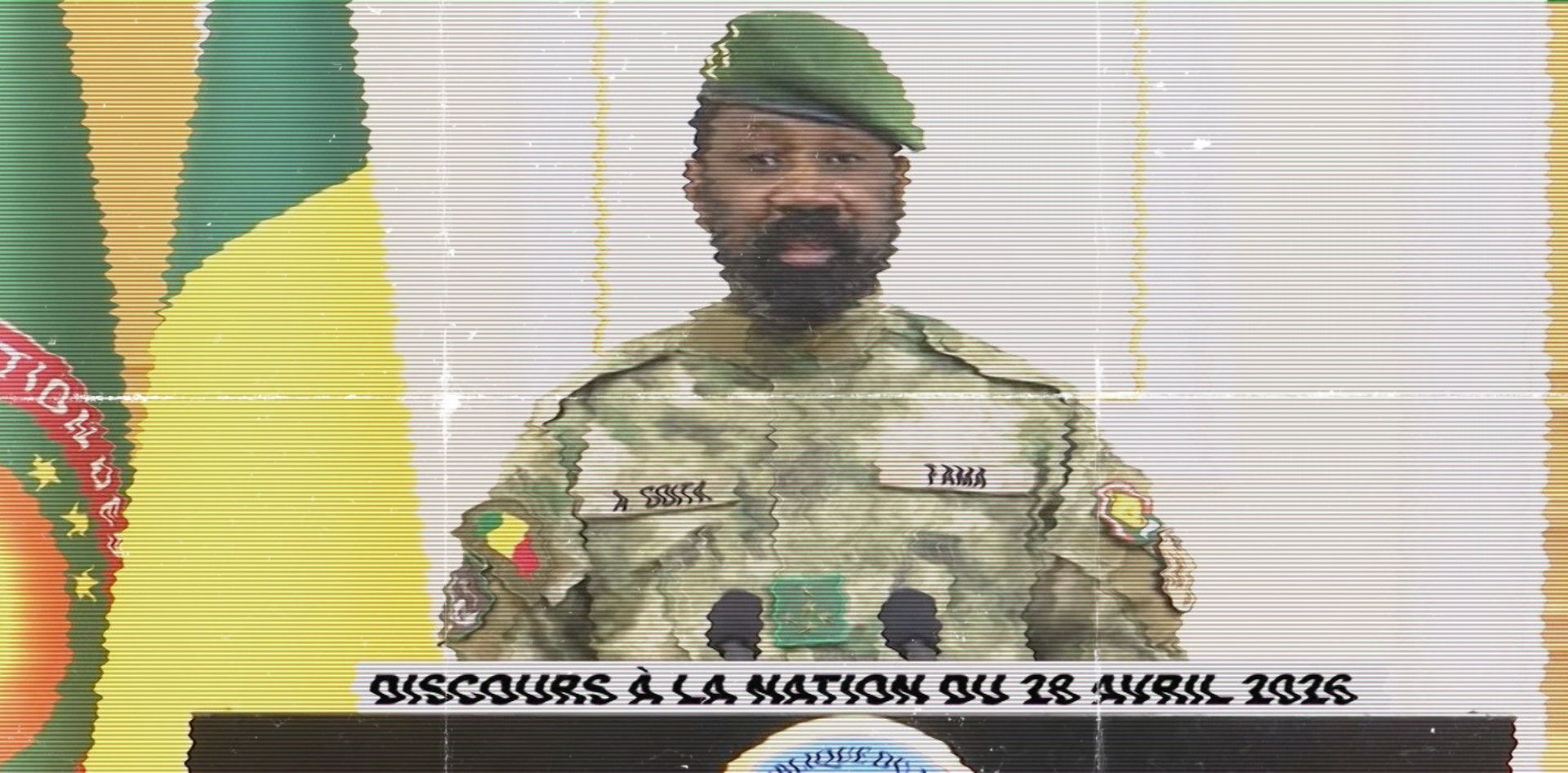
After three days out of sight, Assimi Goïta finally reappeared on 28 April. In a televised address, he claimed the situation was “under control,” a statement contradicted by FLA declarations as well as by numerous reports from the field and by the gradual tightening of a blockade around Bamako.
To better understand the stakes behind these attacks, we asked four questions to Yvan Guichaoua, a member of the editorial board of Afrique XXI, a researcher in international conflict analysis whose work focuses in particular on the political crisis and security governance in the Sahel.
“FLA has sacrificed its diplomatic capital”
Michael Pauron: What lessons can be drawn from the alliance between JNIM and the FLA?
Yvan Guichaoua: The sequence is staggering in terms of scale and logistical performance. So many attacks, in so many places, across such a vast territory—1.24 million square kilometres—without being detected in advance, is historic. It represents a monumental shock in Malian history, likely surpassing the war that began in 2012. That year, the rebellion started in what was ultimately a fairly typical manner compared with previous cycles of insurgency, with gunfire in Menaka, Gao, Timbuktu, Kidal—already significant from a logistical standpoint. But Bamako was not part of the equation.
Until now, it was not thought that JNIM and the FLA could coordinate so effectively. That said, such an alliance had been intensely discussed, but few expected it to materialise because of disagreements over political projects. These obstacles now appear to have been partly overcome—though that does not mean the alliance will last—at least for the purposes of these offensives. This coordinated military deployment clearly bears the hallmark of the recognised strategist Iyad Ag Ghaly, who likely also carefully mixed units to accommodate community sensitivities. For its part, the FLA has deliberately abandoned its cultivated image as a “secular” movement aimed at appealing to Western decision-makers. In doing so, it has effectively sacrificed its diplomatic capital in favour of achieving what it sees as a far more urgent objective: removing the military regime.
Michael Pauron: What are the immediate political consequences of these attacks?
Yvan Guichaoua: In addition to coordinating attacks on multiple fronts, the armed groups succeeded in eliminating a key figure in Bamako—Defence Minister Sadio Camara. This destabilises the regime, which is governed by a quintet of generals, each grounding their power in a loyal faction of the army. Removing one of its most prominent members disrupts the entire system. We are now facing a vertiginous moment of uncertainty, with unanswered questions: who is in command? Who takes over?
The junta leader, Assimi Goïta, disappeared for three days before reappearing on 28 April with a speech that was far from reassuring. His physical condition—sweating, shortness of breath, poor rhetoric and delivery—was deeply concerning. He announced nothing new, simply asserting that the regime would eliminate the threat as if nothing had happened, despite having just suffered the most severe blow ever dealt to a Malian regime.
It should also be noted that this attack “crowns” five years of a regime that has extinguished all political resistance through coercion and intimidation. The military has had free rein to govern as it saw fit throughout this period. The insurgent offensive is therefore necessarily a failure for which they bear responsibility. They invoke the spectre of international sponsors of terrorism, but this is propaganda and denial. They cannot admit that the roots of this crisis are Malian, and they continue to throw up smokescreens to conceal their responsibility. In this context, their capacity to initiate a dynamic that goes beyond merely preserving their regime in the short term remains an open question.
The departure of the Russians, the primary objective of the FLA and JNIM
Michael Pauron: What is the position of the Russians, allies of the junta since 2022?
Yvan Guichaoua: The Russian stance is rather puzzling. On 28 April, Assimi Goïta appeared alongside Russian representatives to signal their solidarity with Mali. The Russian embassy in Bamako issued a statement claiming to have prevented a coup attempt and asserting that they would always stand by Mali. On social media, Africa Corps has released footage of drone strikes to demonstrate its military activity. This is a double-edged message: reassuring for the regime but also highlighting its extreme dependence on Russian forces.
At the same time, this communication contrasts with images of Russian troops withdrawing from Kidal after negotiations, and from Tessit in the Gao region. Kidal is a powerful symbol: the Wagner flag had been raised over the fort following its recapture in 2023. The junta later used this to claim it had outperformed its civilian predecessors by returning Kidal to Malian control. The shifting fortunes of Kidal in recent years are therefore closely tied to Russia, both in victory and in defeat.
There are now questions about the effectiveness of the Russian strategy and the future of cooperation with Moscow. The Malian regime and the Russians are applying patchwork solutions to this inglorious episode. But the Russians are highly pragmatic: if Malian soldiers fail to fight with the expected determination and if Russia finds the situation slipping out of control and incurring losses, they may do as they did in Syria and withdraw. In any case, their departure is the short-term objective of both the FLA and JNIM.
Michael Pauron: What political alternative is being proposed by JNIM and the FLA?
Yvan Guichaoua: Despite this military sequence and the instability within the regime, no clear political offer is emerging, neither from the junta nor from the insurgents. Political figures are waiting in the wings, ready to step forward in a Mali freed from the junta, but no one is making a move yet, as doing so would risk being seen as a puppet of JNIM.
This raises questions about what happens next in the absence of a more political dynamic. Are we heading towards an escalation of violence? There have already been lynchings in Bamako, where suspected terrorists were stoned by crowds. These incidents are worrying and could signal the beginning of a dangerous communalisation of violence.
For now, the use of violence by JNIM and the FLA appears relatively “controlled”: although the attack on the Defence Minister caused significant civilian casualties, the primary target was military.
In this sense, the events of 25 April were not an episode of “unrestrained” violence, nor were they akin to a Hayat Tahrir al-Sham-style campaign, which toppled Bashar al-Assad’s regime in Syria in 2024 using conventional military methods. However, JNIM and the FLA have so far demonstrated a certain level of discipline. Their troops have followed central command precisely to carry out operations across the country, suggesting a degree of political responsibility among the attackers.
These movements have been communicating and planning for months, and they appear to have a strategy—perhaps not yet fully structured, but with identifiable phases: expel the Russians, bring down the junta, initiate discussions, and facilitate the return from exile of civilian figures, particularly from the opposition. However, caution is essential, given how the violent history of the Sahel in recent years has repeatedly defied predictions.
