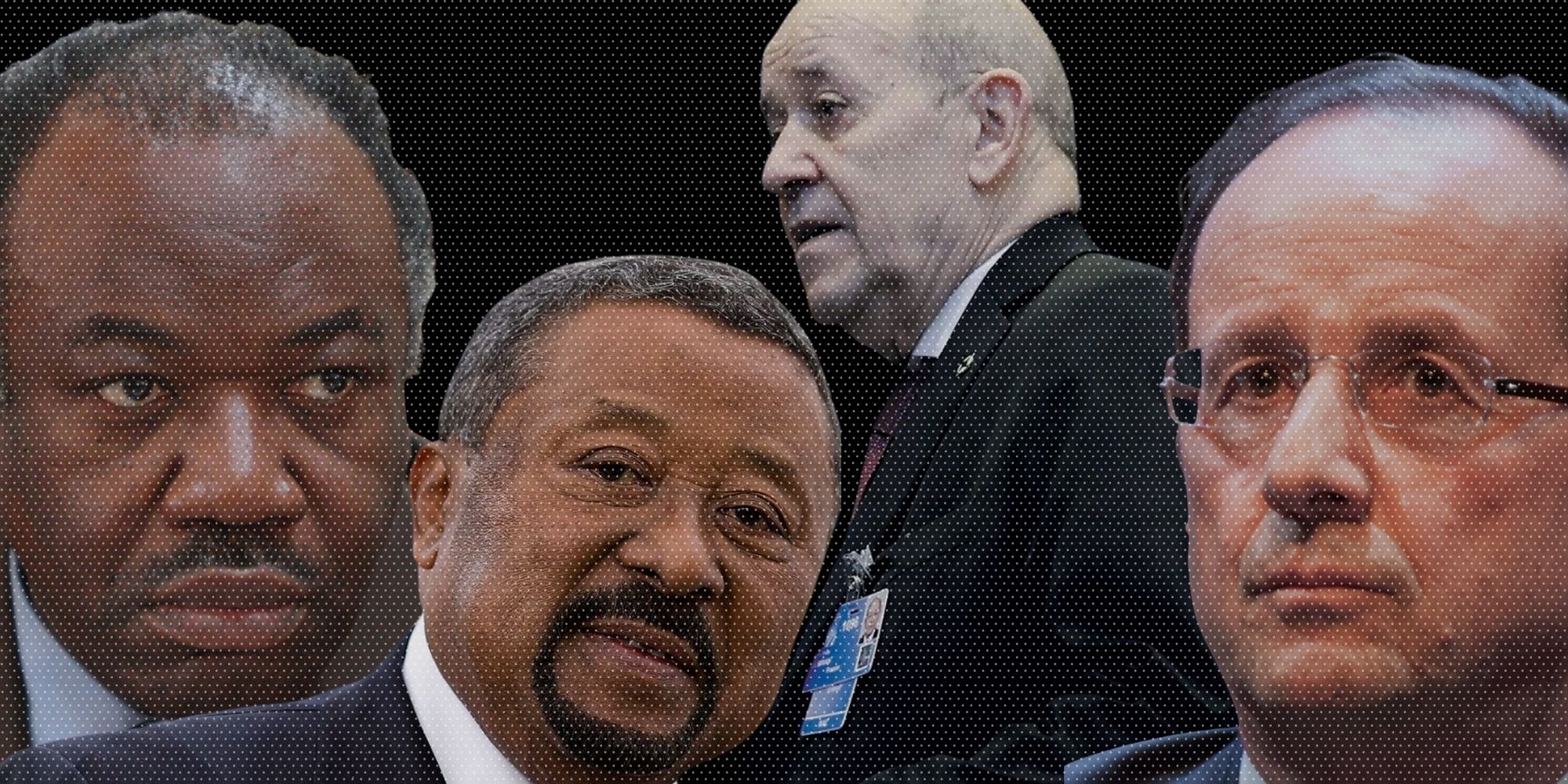
Gildas Ngomba still carries a deep bitterness over the events of 31 August 2016 in Libreville: that year, he says, France “decided to play it quiet, to watch, to let things happen… despite the people out on the streets.” Ten years on, Gabon was living through one of the darkest episodes in its history, and France’s conduct at the time, under the socialist president François Hollande, still raises questions today.
That day, the results of the 27 August presidential election, announced by the interior ministry, gave victory to the incumbent, Ali Bongo, with 49.80 % of the vote against 48.23 % for his main rival, Jean Ping. The wafer-thin margin was disputed by the opposition, which mobilised its supporters. The Bongo regime wobbled, and unleashed a fierce crackdown to cling to power.
Large numbers of protesters fell back on Jean Ping’s campaign headquarters. The five-storey building stood by the seafront, close to the French military base where between 300 and 400 troops were stationed. Several prominent figures — the politicians Zacharie Myboto, Bertrand Zibi and René Ndemezo Obiang among them — were inside the building, though Ping himself had already left. The first wounded were being treated there. In the middle of the night, security forces broke down the doors. Ping’s supporters soon heard the “thwack-thwack” of helicopter blades and were blinded by its searchlight. Point-blank gunfire shattered windows, tore through walls and left many casualties. “When I saw people starting to fall, I couldn’t believe it. Killing people inside a private compound because they’d voted the wrong way… it was unbelievable. We never imagined anything like that,” recalls Blanche Simonny-Abegue, who was then part of Ping’s communications team and now coordinates the Gabonese branch of the Tournons la Page coalition.
In the early hours of 1 September, the attackers — identified as belonging to the Republican Guard (GR) — cleared out. After sunrise, gendarmes loaded survivors onto trucks. Dozens of people were taken into custody. Several of them, including some interviewed by Afrique XXI, say they were subjected to unlawful detention and torture — a claim corroborated by Emmanuel Altit, one of the victims’ lawyers. Civil society groups put the death toll at at least thirty. The names of these “martyrs” resurface every year at the 31 August commemorations, even printed on participants’ T-shirts.
A long-standing ally to the Bongos
Ever since Omar Bongo took power in 1967, France has kept close ties with the Bongo family, which became a pillar of the “Françafrique” network. In 2008, President Nicolas Sarkozy travelled to Gabon for the patriarch’s funeral — a potent symbol as his son Ali prepared to take the reins.
By 2016, when the election was held, the socialist François Hollande had been in power for more than four years, and Paris’s stance looked more ambiguous. It made several statements casting doubt on the credibility of the vote, yet ultimately came to terms with Ali Bongo’s disputed victory and said nothing about the crackdown that followed.
On 1 September, at the Ambassadors’ Conference in Paris, the day after the assault on Ping’s headquarters, foreign minister Jean-Marc Ayrault told reporters that “doubt has set in” over the vote’s credibility1. On 28 August 2016, the Socialist Party had already declared2: “For more than half a century, the Bongo family has governed Gabon. A change of power would be a sign of good faith, and an example to follow.” During the protests, the French embassy helped people who were in danger, offering protection or assistance in leaving the country, several witnesses recall, among them MP Jean Gaspard Ntoutoume Ayi.
Ntoutoume Ayi, an opponent of Ali Bongo in 2016, recalls that “France considered it a Gabon-on-Gabon crisis and left it to the European Union to act.” That was the line taken by Jean-Marc Ayrault too. Also on 1 September, he insisted that “this is an internal Gabonese matter,” ruling out any French intervention.
François Hollande’s “schizophrenic” stance
On 24 September 2016, the Constitutional Court upheld Ali Bongo’s re-election, adjusting the figures slightly to 50.66 % against 47.24 %. Paris ultimately accepted these disputed results — even though European observers had themselves denounced a lack of transparency and “irregularities”3 — and imposed no sanctions over the 31 August massacre. Its position did not shift even under pressure from the European Parliament, which a year later — Emmanuel Macron having just succeeded Hollande — called on France to “bring the whole of its political and economic weight to bear on the Gabonese government […] given its strong historical ties with Gabon”4. This inconsistency was noted by the researcher Matthieu Fau-Nougaret, who, questioned in 2017 by the channel Public Sénat5 about Hollande’s Africa policy, judged that his presidency had been marked by a “schizophrenic” positioning.
Afrique XXI was unable to reach the former ambassador, Dominique Renaux, but diplomats recall a period that was distinctly “intense.” The embassy’s first counsellor, Hugues Nordi, was even threatened with death in a satirical newspaper, which accused him of plotting a coup with Jean Ping6. A senior foreign ministry official maintains that “at the Quai d’Orsay, the leaning was rather towards a transparent count, which could have put Jean Ping in power.” That reading seems to be borne out by Ayrault’s 1 September statement, in which he also called for “election results to be released polling station by polling station,” insisting that “the results of this vote must be perfectly clear and transparent.”
But the same official also says he understood that “the intelligence services wanted the status quo — in other words, Ali Bongo.” That, de facto, was the line the Élysée ultimately took. In an interview with Le Monde in November 20167, Jean Ping accused Paris of nothing less than “torpedoing Europe’s position on the election results.”
One thing is certain: as the assault on the opposition leader’s headquarters unfolded before the eyes of French troops, France did not so much as flinch.
“Paris could not have been unaware of the preparations”
Jean-Yves Le Drian — the man behind French military operations in the Sahel (Serval in 2013, later folded into Barkhane, which ran until 2022) — was defence minister at the time. In 2013 he had relied on Ali Bongo8 and on the French Forces in Gabon (EFG) to intervene in the Central African Republic after the fall of François Bozizé. Later, in 2019, after the Gabonese president suffered a stroke, Le Drian defended the regime before the French National Assembly9, even as the opposition — increasingly backed by public opinion turning against the Bongo clan — argued he was no longer fit to govern and demanded early elections. Under Hollande’s presidency, Le Drian had grown so central to French policy on Africa that, as one diplomat told Libération
in 2015, “for many African heads of state, whoever sees Le Drian sees Hollande.”
The victims of 31 August 2016 today blame France for this hands-off approach. For Emmanuel Altit, the lawyer who in December 2016 filed a complaint before the International Criminal Court (ICC) prosecutor on behalf of Jean Ping, Gabonese civil society figures and victims of the crackdown, “the French authorities could not have been unaware of the preparations for, and the attack on, Jean Ping’s headquarters […]. Gabonese citizens could not escape the French surveillance apparatus.” In other words: could French intervention have prevented a massacre? The ICC proceedings, for their part, never led to a formal investigation.
Several witnesses further allege that French nationals were directly or indirectly involved in the attack on the opposition leader’s headquarters. Speaking to Afrique XXI, they say the helicopter pilot was a “white” man — which, in itself, says nothing about nationality. But Republican Guard aircraft were indeed sometimes flown by former French officers working for Gabon, according to various sources — GR members, technicians — interviewed at the time. Others (sometimes the same people who saw the pilot) say they recognised French accents among the troops who carried out the assault. “I live and work alongside French people, I know the difference between accents very well, and during the attack on the headquarters I clearly heard people from France,” testifies Blanche Simonny-Abegue. “At one point I heard them say: ’We’ve come to secure you…’”
Former French soldiers serving the Republican Guard
Between 2016 and 2018, victims filed complaints in France. Afrique XXI has seen some of these, which name several French nationals (all presumed innocent): “Alain Grandjean,” described in the documents as the number two of Gabonese intelligence, who commanded Republican Guard units and was on board the helicopter during the assault; “Stéphane Chiron,” identified as an adviser at Gabon’s defence ministry who allegedly co-ran the crisis command post and attended some interrogations; “Georgie Christine,” a member of the presidential security detail accused of overseeing the commando that attacked Ping’s headquarters; “Jacques Tropin” and “Franck Couedel.” The status of these French soldiers or ex-soldiers remains unclear. Online research shows that Christine, Tropin and Grandjean served the Gabonese state within the Republican Guard after leaving the Foreign Legion or the regular army10. The status of a certain “Franck Couedel,” and whether he was in Libreville at the time, could not be verified. The complaint also names Frédéric Bongo. Ali Bongo’s half-brother, who holds dual French-Gabonese nationality, was then head of the special services, the presidency’s powerful intelligence arm.
In a letter sent to François Hollande11 at the end of 2016, members of the Gabonese diaspora asked the French president to open an inquiry into the responsibility of two officers, including Stéphane Chiron. Asked about the status of these soldiers at the time, the armed forces ministry said it was not its place to comment “on personnel who are, or may have been, under contract with the Gabonese Republican Guard.”
In 2017, a judicial investigation was opened, and by June the investigating judge had settled on the charge of “crime against humanity.” The inquiry — covering allegations of “false imprisonment and arbitrary detention committed as part of an organised group, torture and acts of barbarity committed as part of an organised group, attempted murder, and crimes against humanity committed in Gabon during the 2016 post-election crisis” — was handed to the Central Office for the Fight against Crimes against Humanity and Hate Crimes (OCLCH).
In July 2020, the OCLCH asked the Quai d’Orsay for all its documents relating to Gabon’s post-election crisis, including its correspondence with the French embassy. But of the 315 documents available, only 35 were handed over to the OCLCH, according to reporting by Marianne in March 202612. In 2024, a senior Quai d’Orsay official denounced this obstruction and reported it to prosecutors. Speaking to Afrique XXI, he explains he did so over what he calls “a refusal to hand over documents,” under Article 40 of the French Code of Criminal Procedure, which requires any official aware of a crime to report it to the public prosecutor.
Oligui Nguema in no hurry to deliver justice
Internal documents implicate Christophe Bigot, the Quai d’Orsay’s Africa director, and Nicolas Roche, then chief of staff to minister Jean-Yves Le Drian, in deciding which documents were passed on to investigators. In an email seen by Afrique XXI, Bigot instructed his team that only documents concerning French victims should be handed over — an “interpretation,” the whistleblowing official says, denouncing it in his report to prosecutors alongside what he calls internal “pressure” “to limit the scope of the documents to be transmitted.” The Quai d’Orsay eventually sent a second batch of documents — 81 this time.
Christophe Bigot told Afrique XXI that “all of this was done by the book.” In his view, “it falls to the foreign ministry to search through all available documents for those that answer the justice system’s requests,” adding that “the selection is made on the basis of all the opinions gathered, and after deliberation, in line with the procedures in force.”
The foreign ministry, for its part, said it “does not comment on an ongoing judicial investigation [the OCLCH inquiry is still under way, ed.] and cooperates fully with the judicial authorities, providing all information required and responding to formal requests, as it is bound to do.”
In Gabon, some are still fighting to see the dead of 2016 honoured, and to move past their own trauma. Aïcha Tsoumbou, who founded the Association Réconciliation, is one of them. But this former nurse, who was at Ping’s headquarters on 31 August 2016, is regularly threatened and has been detained by police on several occasions13. Gabon’s new authorities, in power since the August 2023 coup, evidently have little appetite for reopening the case: the current president, Brice Oligui Nguema, comes from the Republican Guard himself — the very body that bore heavy responsibility for the massacre.

1«Gabon. La France demande des résultats bureau par bureau», Reuters, 1er septembre 2016, as carried by Impact SN.
2«Élection présidentielle au Gabon : le Parti socialiste espère que la démocratie l’emportera», Parti socialiste, 28 août 2016, available here.
3Action extérieure de l’Union européenne, «La Mission a présenté sa Déclaration préliminaire à Libreville», 30 août 2016.
4«Résolution du Parlement européen du 14 septembre 2017 sur la répression de l’opposition au Gabon (2017/2830(RSP))», 14 septembre 2017, available here.
5Marie Wolfrom, «Hollande et l’Afrique: des guerres et la fin d’une certaine Françafrique», Public Sénat, 12 janvier 2017.
6Africa Intelligence, «Hugues Nordi en crise – diplomatique – avec Libreville», 2 janvier 2016.
7Christophe Châtelot, «Jean Ping : “Les Français ont torpillé la position de l’Europe sur les résultats de l’élection”», Le Monde, 9 novembre 2016.
8«Gabon: Jean-Yves Le Drian évoque la Centrafrique avec Ali Bongo», AFP, 22 novembre 2013.
9According to the websites Mondafrique and Africa Radio, the minister’s remarks were tidied up in the official transcript. According to them, Jean-Yves Le Drian actually said: “So President Bongo suffered a stroke, he is recovering in Morocco, and we can hope he will be able to resume his normal activities. He was elected, the National Assembly was elected, there is a government, the institutions are functioning — that is the reality.” The video has since been removed from the National Assembly’s website. The official transcript (available here) was somewhat softened: “We note that the institutions are functioning, in keeping with the Constitution, and that is what matters. The Government governs, the new National Assembly resulting from the legislative elections has been installed.”
11Griffin Ondo Nzuey, «Violences postélectorales : deux officiers français mis en cause par le Diagau», Gabon Review, 25 décembre 2016.
12Maël Jouan, «Le Quai d’Orsay a entravé une enquête pour crimes contre l’humanité au Gabon», Marianne, 05 mars 2026.
13Jocksy Andrew Ondo-Louemba, «Gabon, une militante des droits de l’homme battue par les militaires», Mondafrique, September 2024.