Zeinab Badawi is a journalist born in Sudan and raised in Britain from the age of 2. She had a long career in television (ITV Yorkshire, Channel 4 News, the BBC…) and as a documentary-maker, notably producing a twenty-part BBC television series on Africa, “The History of Africa”, broadcast in 2020. She later moved into academia, becoming president of the prestigious School of Oriental and African Studies (SOAS) in London in October 2021. She is also an honorary fellow of her former Oxford college. She sits on the boards of several influential organisations, among them the International Crisis Group, Afrobarometer (based in Ghana), and the Mandela Institute for Development Studies.
Her father, Mohammed-Khair El Badawi, was a Sudanese journalist and activist heavily involved in pre-independence Sudanese politics, before joining the BBC’s Arabic service in London. She is also the great-granddaughter of Babikr Bedri, a pioneer of women’s emancipation in Sudan.
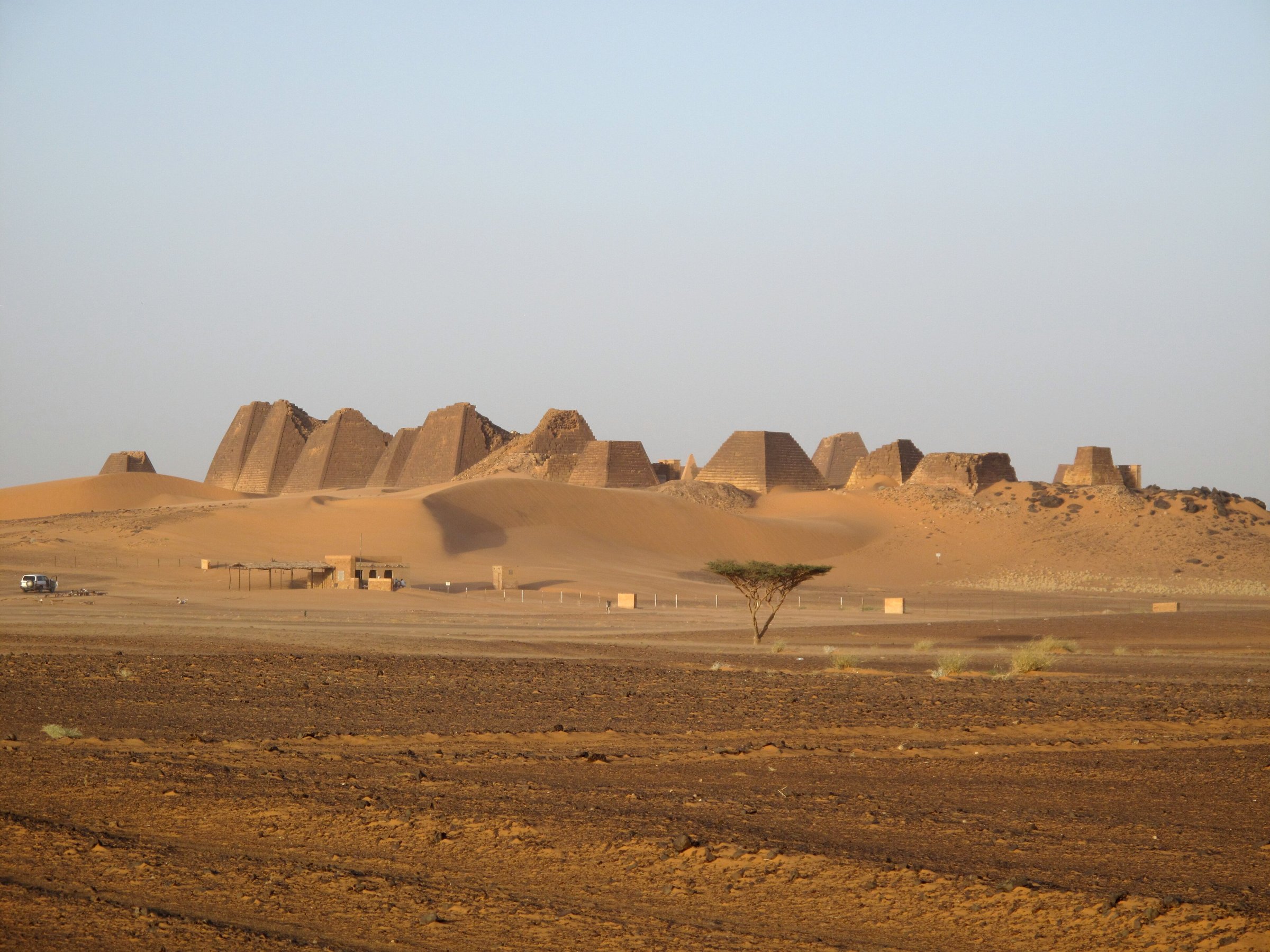
At 66, Zeinab Badawi has stepped back from television studios and journalism. She now runs a communications firm, Kush, named after the powerful kingdom (1070 BC – 350 AD) that once spread across the confluence of the Blue Nile, the White Nile and the Atbara river, in what is now northern Sudan and southern Egypt. Her company produces documentaries and advises organisations and businesses.
On 18 September, the Paris-based Éditions du Faubourg publish the French edition of her book An African History of Africa (Une histoire africaine de l’Afrique, translated by Eric Faye), which came out a year earlier under W.H. Allen. She drew on dozens of interviews with researchers across the African continent, many of them conducted while filming the episodes for the BBC series.
She makes no secret of her ambition to offer a “de-Westernised” — and decolonised — account of the continent’s history, accessible to everyone. She is also working on a version for younger readers. Her work was inspired in particular by Unesco’s eight-volume General History of Africa.
Victoria Brittain: What was the spark that set off this whole undertaking?
Zeinab Badawi: I had no idea, on a sunny afternoon in the summer of 2013, sitting in the office of my friend Getachew Engida, an Ethiopian who was then Unesco’s deputy director-general, that I was about to set off on a great intellectual journey. As we drank tea, I noticed a bookshelf behind him holding a set of volumes titled General History of Africa, the GHA. He explained that it was a history of Africa written from its origins to the modern era, most of it by African intellectuals.
It was a project launched in the early 1960s, at that moment of rapid African decolonisation, when newly independent African leaders felt that, with their countries now decolonised, their history needed decolonising too, and needed to be written from an African point of view. Unesco backed the ambition and set up a committee of African academics to oversee this extraordinary undertaking. I told my friend I wanted to make a BBC television series drawing on these volumes, to tell the history of Africa with Africans. So I travelled, over six and a half years, to some thirty countries across the continent, interviewing dozens upon dozens of historians, anthropologists, archaeologists and cultural experts about the history of their region.
After twenty episodes of “The History of Africa”, a great deal of material remained unused. I felt I hadn’t done justice to the African scholars I had interviewed, and so I decided to write this book. That was the spark for An African History of Africa. Of course, for the book I couldn’t rely solely on interview transcripts; I had to do a great deal more research — fortunately, we have SOAS, one of the finest libraries in the United Kingdom. It took me around two years to write the book. All told, the whole project — television and writing — kept me busy for the best part of a decade.
Victoria Brittain: You’ve said you wished you’d had a book like this as a child. Are you planning a children’s version?
Zeinab Badawi: Yes, I’m working this year on an illustrated edition for young readers, say 7 to 11-year-olds, due out sometime next year, and I’m also writing a version for children of around 12 to 16.
Victoria Brittain: What was your relationship with the African academics like?
Zeinab Badawi: Every academic I interviewed is brilliant. I think there are good Africanists elsewhere in the world doing remarkable work on Africa, but there’s undoubtedly something more powerful when someone from the country or region itself speaks about their own history. It seems to add an essential dimension. I felt these African academics’ accounts carried more weight because it was their own story they were telling, and because they speak the local languages and are therefore more attuned to oral tradition than some Africanists are.
What’s more, they turn the telescope round and look at history from their own vantage point. A distinguished Nigerian historian, Professor Muywai Falaiye, put it to me this way: “A Black person has to write their own history, to speak for themselves, in order to offer a different perspective from the one orchestrated by the West — and I say that bearing in mind that no one can explain your history better than you can yourself. If you approach African history and its belief systems with a Western mindset, you’re bound to misunderstand what the African represents. You need to understand what Africans do, why they think the way they think. To me, that matters enormously: telling the history isn’t enough — understanding the African mindset matters even more.”
Victoria Brittain: Could you tell us about some of them?
I could name so many remarkable people, and they’re all in the book. Take the Cameroonian professor Augustin Holl, a genuine polymath. Trained as a palaeontologist, he chaired the GHA’s international committee. The breadth and depth of his knowledge are, quite literally, astonishing. He was a real source of inspiration for the whole book.
Two brilliant Liberian academics, Carl Patrick Burrowes and William Ezra Allen, gave me fascinating insights into what drove the abolition of the transatlantic slave trade and the arrival of freed African-Americans from the United States. Dr Kitouni Daho is one of Algeria’s foremost specialists on the Numidians, those key allies of Rome whom the Roman historian Livy described as “by far the best horsemen in Africa”.
Professor Doualye Konaté, one of Africa’s most eminent academics, spoke to me at length about the 1236 “Manden Charter”, which granted freedom, dignity and equality to every citizen of the Mali empire founded by Sundiata Keita. Professor Nigel Penn, of the University of Cape Town, has written extensively on the first European settlers in what would become South Africa, and on how they treated the Khoi and San peoples on their arrival. He works to debunk the myth of the “empty land” these Europeans supposedly arrived on.
These are just a few of the many academics I met. I’ve tried to faithfully convey some of their views, their research and their conclusions.
Victoria Brittain: As a woman of Sudanese origin, what did you learn about your country of birth?
The period of ancient Sudanese history I focused on is the 8th century BC, when Sudan was not just a great African civilisation, but a superpower — one that protected the princes of Byblos and Tyre, in modern-day Lebanon, and King Hezekiah of Judah, and that fought the formidable Assyrian army.
Dr Shadia Taha, a Sudanese archaeologist, taught me a great deal, particularly about the history of ancient northern Sudan. The Egyptologists and archaeologists who went to work in Sudan long regarded ancient Sudan as a colony, or a mere offshoot of Egyptian culture — one that supposedly did nothing more than imitate Egypt and passively absorb its knowledge. Dr Taha’s research has shown that, in reality, the two civilisations influenced each other, and that ancient northern Sudan had been, in its earliest form, an advanced civilisation that predated ancient Greece and Rome — yet one that has never received the recognition it deserves.
Victoria Brittain: East Africa was profoundly shaped by the arrival of the Arabs, whether through the slave trade eastward, the fusion of African and Arab cultures, or the spread of Islam…
Zeinab Badawi: The Arabs made contact with Africans as early as the 7th century — centuries before the Europeans. They brought their religion, Islam, with them, of course. They helped spread literacy, since many African Muslims learned to read the Quran and even wrote in Arabic. Arabs sometimes settled and forged marriage alliances with local populations, as in East Africa. By 711, the Arabs had all but completed the conquest of North Africa. The history of Africa is therefore inextricably bound up with the Arabs, their language and Islam.
The grim aspect of this is that 14 million Africans were deported by Arabs and their partners between the 7th and 19th centuries to Arab lands, as well as to the Persian Gulf and India. That substantial estimate covers every route — across the Sahara to North Africa and the Arab families living there, as well as across the Red Sea, the Mediterranean and the Indian Ocean. The great majority, close to 10 million, were transported via the Indian Ocean.
Victoria Brittain: Is the subject of the Indian Ocean slave trade taboo, and why?
By the 9th century, most of East Africa’s coastal towns were predominantly populated by Swahili people, whose culture combined African, Arab and, to a lesser extent, Indian elements. Many Swahili had converted to Islam and proved willing partners for the Arabs in the acquisition of enslaved Africans. There is deep reluctance to address this trade, both in the Arab world and in East Africa itself — the understandable discomfort of Muslim Swahili communities over their ancestors’ involvement in this trade makes any open discussion of the subject particularly uncomfortable.
According to Professor Felix Chami, a Tanzanian historian, the merging of African and Arab cultures and the adoption of Islam created “a major problem in the history of coastal East Africa”. He argues — and many African academics share this view — that the Swahili’s proximity to the Arabs made it easier for some of them to acquire non-Swahili African captives for enslavement.
In the Arab world, the only exhibition devoted to this subject is in Qatar, in a museum that opened in 2015, built on the site of a former slave trader’s house. And there is no debate there over reparations of the kind we’re familiar with regarding the transatlantic slave trade1.
Victoria Brittain: Can Arab slavery and transatlantic slavery really be compared?
Slavery remains slavery, but there are major differences. Transatlantic slavery was built on the ownership of people and favoured men for plantation labour. Arabs, on the whole, preferred enslaved women, destined to become concubines or domestic servants. Another key difference: if an Arab man fathered a child with an enslaved African woman, that child was born free and could even rise to high social standing. What’s more, enslaved African men in the Arab world could serve as soldiers, scribes, musicians and so on; they were not confined to hard labour alone.
That said, one particularly cruel aspect of their enslavement by Arabs is that many were castrated to serve as eunuchs, tasked with guarding women within households. In the transatlantic trade, if a white man fathered a child with an enslaved African woman, that child, too, was born into bondage.
Victoria Brittain: What did you discover, over the course of your travels, about attitudes towards restitution and reparations?
Zeinab Badawi: I think the more objects are returned, the more momentum can be sustained. The great majority of African academics I spoke to want to see their artworks restituted. I’ve visited many museums across the continent and found that they display very little of real significance: the centrepieces are often mere replicas of the originals, which remain held in Western museums or collections.
Victoria Brittain: The subject of reparations sparks fierce debate…
A unified position among people of African descent would make things easier. The plan put forward by the Caribbean Community (Caricom) strikes me as sound2. Taken up by the African Union, it essentially defines reparations as development aid. And at a time when development aid is being scaled back, that would be one good way of making up the shortfall.
Victoria Brittain: A strong thread runs through your account: that of the heroic women of African history, from the collective political suicide of the rebel women of the village of Walo, to powerful queens such as Queen Idia of Benin, Queen Njinga, who resisted the Portuguese and their slave trade in the kingdom of Ndongo (present-day Angola), and Yaa Asantewaa of Ghana, exiled to the Seychelles, where she died. How present are they in the imagination of the new generation?
Zeinab Badawi: Many people underestimate the role women played in shaping the continent’s past. There are plenty more examples beyond the ones you’ve mentioned, and really, any one of them could be chosen to illustrate their strength and significance. How present are they in the imagination of the new generation? Let me give you a striking example: the queen mothers of the ancient kingdom of Kush, in northern Sudan, who wielded enormous power. Some of them led their armies into battle. They could act as co-regents alongside their sons or husbands. They were known as Kandakas.
And in April 2019, when Sudan’s young people rose up against President Bashir’s dictatorship, women were very much at the forefront of the movement. They called themselves Kandakas. They drew on Sudan’s distant past to assert themselves on today’s social and political stage. Similarly, Yaa Asantewaa has become a national symbol in Ghana. She appears on coins, banknotes and stamps, and a girls’ school was even named in her honour when Ghana won independence in 1957 under President Kwame Nkrumah, who turned her into a genuine national icon.

1The Committee on the Elimination of Racial Discrimination, a panel of independent United Nations experts, found in a report submitted on 1 September that “States parties must implement comprehensive reparation measures for people of African descent, covering all aspects of reparations.”
2See in particular « Les Caraïbes plaident pour une justice réparatrice », Unesco, 21 June 2024.