The current war in East Congo has been going on for four and a half years. It is the sixth or seventh Rwandan aggression of the DRC, whereby each time local grievances in the DRC are manipulated by Kigali to implement its own security and economic agenda. This is as long as the previous and more comprehensive 1998-2002 war, and it has basically the same causes, putting a Rwandan expansionist military strategy against an ineffective management of the state and its army in the DRC. It seems that Mobutu, Joseph Kabila, and Felix Tshisekedi all seem to consider an efficient army as a potential threat to their personal power.
President Tshisekedi maintains consistently an anti-Kagame stance, earning him some popularity all over the country. His failure to make this a reality on the ground however creates doubts about his real intentions or at least about the realism of his strategy. Some observers say that President Tshisekedi takes advantage from the ongoing war to implement his personal political agenda - which unfortunately may throw the country into even deeper instability.
A new constitution in times of war?
Tshisekedi indeed wants to modify or to replace the current constitution, allegedly for technical flaws in the current text, dispositions allowing foreigners to appropriate DRC natural resources, or problems with decentralization of prohibiting efficient governance. None of these arguments currently justify a constitutional overhaul in a situation of war with the Rwanda-supported M23/AFC movement. The real objective is clearly the abolition of the limits to presidential mandates, which would allow the current president to remain indefinitely in power.
The regime in power goes ahead. A law proposal to organize a referendum is currently being approved in the DRC parliament, and it includes a procedure for constitutional modification or replacement starting with the preliminary creation of a consultative commission. This would be followed by the transformation of the current parliament into a constituent assembly which would approve the new constitutional text before submitting it to a referendum.
Legitimacy problems
Obviously, every people has the right to modify the constitutional rules. However, the adoption of a new constitution or substantially new constitutional order requires legitimacy, a broad consensus, and a climate of peace.
The current Parliament, which according to the law on referenda would become a constituent assembly, lacks the necessary legitimacy to engage in a reform as fundamental as the re-writing of the DRC Constitution. The 2023 legislative and presidential elections were indeed widely recognized as fraudulent and marred with many irregularities: the many fake votes falsified the result – which were never published in detail. The composition of the National Assembly reflects internal political arrangements among the political elite rather than the popular vote. The coalition in power is also dominated by members of the President’s community of origin and support, reducing its representativeness in a country where balanced representation has always been key to its legitimacy. The many protests from civil society and the political opposition demonstrate that a consensus is lacking. The powerful Catholic Church, in its most recent statement dating from 19 June, reject this project fearing the permanent division of the country – with two different constitutions in government-controlled and M23-controlled areas – and even a civil war. The protestant churches declared the organization of a national and inclusive dialogue a necessary condition to introduce constitutional changes – which is refused by President Tshisekedi.
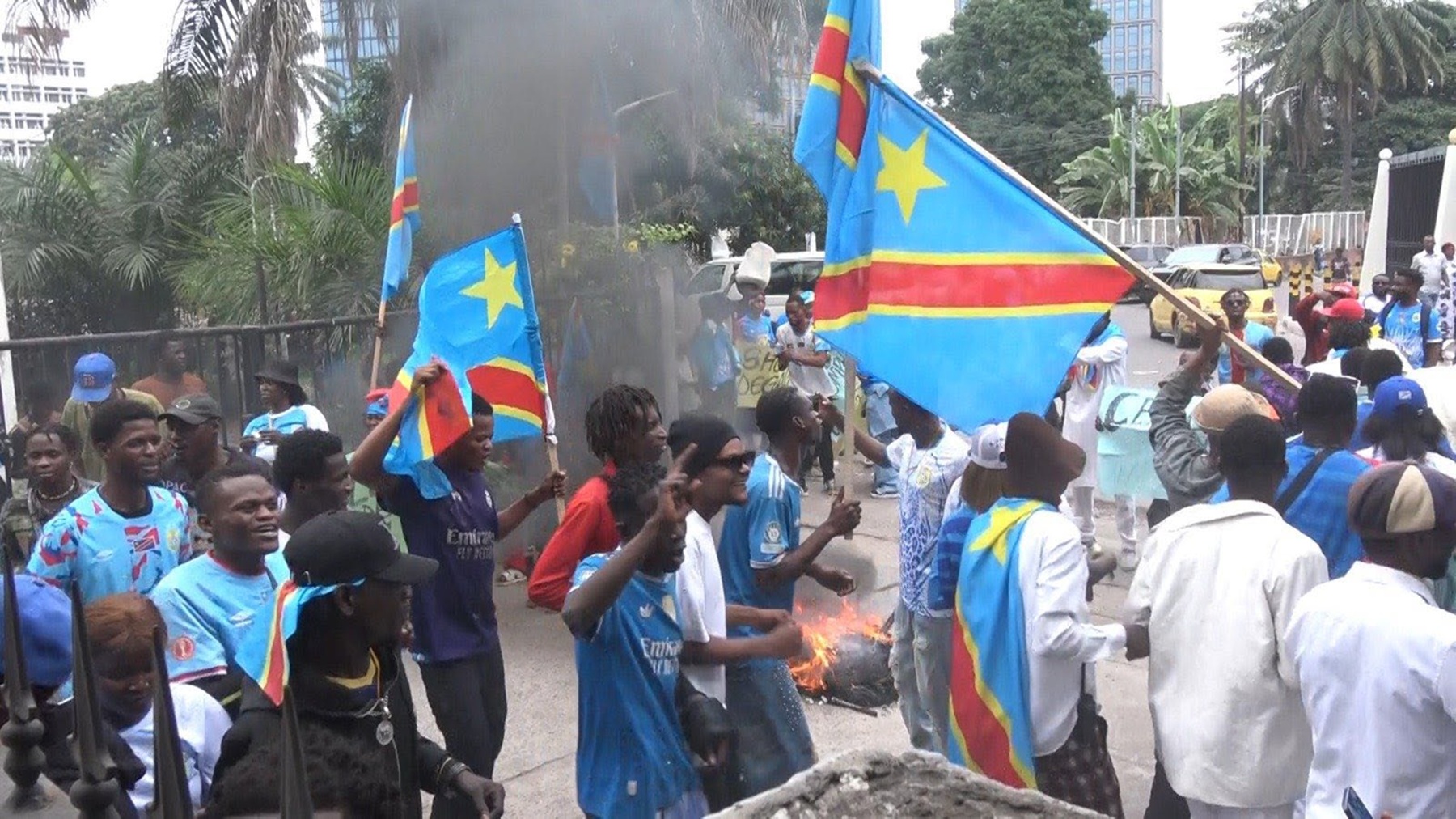
Instead, a state and party-led propaganda machine is currently trying to force through the reform in public opinion, with the help of imposed academic conferences, infiltrated WhatsApp networks, evangelic preachers turning a legal debate into an act of faith, media control, and repression of dissident opinions. A worrying evolution is the mobilization of violent party militias to intimidate opponents to a change, labeling these “traitors working for Kagame.” Violence is used not only against peaceful demonstrations but also targets the Catholic Church. The national police reportedly even cooperate with these militias.
What is at stake?
The implications of this operation may not be underestimated. The current constitution (art. 219) prohibits any modification in wartime or when there is a state of emergency; we have both at present. This disrespect of the constitution does not seem to be of concern to the authorities. More importantly, its replacement, or the modification of its key elements, implies abolishing the constitutional order introduced in 2006, approved by referendum. It also means terminating the political compromise on which it was founded, without reflecting it: the agreements of Sun City and Pretoria concluded between the parties who waged a four-year war in 1998-2002, and by a broad representation of the unarmed political opposition and civil society.
This provided a large support to the 2006 constitution which was drafted by a group of DRC constitutional experts1. One of its key objectives was to resolve the DRC legitimacy crisis since 1960 and to block any return to a Mobutu-like dictatorship. Its art. 220 thus includes a prohibition to touch on the number and duration of presidential mandates, which were fixed at two terms of five years. It includes a system of checks and balances and provisions to integrate and respect minorities. The 2006 constitution ensured political stability until today, even if it must be admitted that both the Kabila and Tshisekedi regimes hollowed out many of its provisions. In sum: this is not the time for an insufficiently representative regime to impose a new constitution when the country is territorially and politically divided.
“Genuine nationalists” vs. “traitors”
To justify the abolition of the 2006 constitution, the current coalition in power considers the entire 1997-2018 period (regimes of Kabila father and son) as dominated by Kigali and thus illegitimate2. They argue that foreigners wrote the constitution and that Joseph Kabila is either Rwandan or at least subservient to Rwandan national interests. Kabila is suspected of supporting financially and politically the M23/AFC movement and was therefore condemned to death by a military tribunal, without tangible proof. The activities of his political party are prohibited and several of its leading officials were arrested. Criticism of the president is prohibited, and a service of digital surveillance identifies and arrests critics on the social media. An important number of military officers, mostly of Katangese origin and supposedly related to Kabila, have been arrested, causing a de-structuring of the government army. Many opposition leaders are in exile. Opponents to the constitutional change are depicted by UDPS militants as “traitors” and “working for Kigali.”
In contrast, the coalition in power portrays itself as genuine Congolese nationalists who redirect the country to its own roots, beyond any foreign influence. This implies a return to the situation in 1997 when Mobutu was forced to abandon power. In fact, the regime currently includes several references to practices reminiscent of the Mobutu regime.
More importantly, the current regime is heading back to the exclusion of the Tutsi population as existed by the end of the Mobutu regime, preparing the area for a new round of violence. Although the persecution of the Tutsis – cited as justification for the attack on Kigali – is not yet institutionalised or systemic, it represents a future threat implied by the stance of the Tshisekedi regime, which constantly refers to ‘true Congolese’. This is intimately tied to the fundamental division in the DRC between the Lingala-speaking West vs. the Swahili – speaking East: with the succession of Kabila by Tshisekedi, the balance tilted over from the East back to the West.
UDPS is beyond current constitutional order
The plan to introduce a new constitution can partly be explained by the history of the UDPS party. The UDPS was created in 1982 by a group of MPs3 and led by the charismatic Etienne Tshisekedi, father of the current president. Under the Mobutu regime it was the biggest, most representative, and most efficient opposition party against his dictatorial rule- but it failed to overtake power. The regime of Laurent Kabila which had come to power with military means, marginalized the UDPS and, during the 2001-2002 negotiations to end the war as well as during the 2003-2006 transition, the UDPS kept itself outside the negotiation process and missed several opportunities to influence the outcome. The party, because of the struggle it has been waging since 1982 first against Mobutu and then again against Laurent Kabila, always considered itself as legitimately entitled to power beyond any negotiation with other members of the political elite. The party also prided itself on its non-violence and refusal to engage in armed struggle. This means that they do not consider themselves as bound either by the 2002 political compromise nor by the constitutional process. They appealed to the population to vote against the 2006 constitution during the December 2005 referendum.
UDPS is no longer what it was
The ruling coalition also has an internal legitimacy problem. Even if the party claims it is legitimately entitled to power, the President ensured that it has limited impact on his own personal rule. The UDPS is currently led on behalf of the presidential family by a contested secretary general who uses party militia rather than experienced party officials to rule and to impose his views. Many long standing and experienced UDPS officials feel betrayed for their many years in struggle for ideals which are no longer respected and replaced by scandals of corruption and embezzlement. At the same time, the prospect of being able to remain in power may silence dissident voices inside the UDPS while many hope still to benefit from “their” regime.
Tshisekedi seems to be convinced that he can push through his political agenda in wartime thanks to the strong support from the USA which took painful sanctions against Rwanda’s government army and leading officers from Rwanda and the M23 for failing to respect the peace agreement undersigned by both the Rwandan and the RDC presidents and imposed by Washington. These sanctions indeed seem to influence a withdrawal of support from Rwanda for the M23.
However, it is not certain that the USA will reap the expected benefits from its unilateral support for Tshisekedi. Its strategic partnership with the RDC includes a maximum of guarantees for the US to secure stable supply lines in CRMs, and the DRC is clearly willing to offer the USA maximum possible entrance into the DRC mining sector. However, the DRC mining sector is still dominated by Chinese interests, and Tshisekedi, in the hypothesis that he recovers East Congo, may easily reveal himself to be a much less trusted partner than expected: his many diplomatic reversals on the international scene are ill-reputed. The US support seems to be founded on a very shallow and short-term understanding of the complexity of the ongoing conflict.
It must be underlined that Tshisekedi does not respect the Washington peace agreement either. He still seems to believe in a military victory over the M23 movement, thanks to the use of drones, foreign mercenaries and the many armed groups which were outlawed before the war but are now officially part of a reserve force of the national FARDC army and known as patriots or wazalendo. The FDLR plays a key role in the government’s offensive operations. Even if the government would reintegrate East Congo into the national realm, it will be confronted with a huge problem of generalized instability because of the armed groups it will no longer be able to keep in line, all claiming their due for the patriotic struggle. The government is currently already incapable of managing the many violent armed groups in Ituri and even in the vicinity of Kinshasa with the Mobondo. Imposing a new constitution in a divided country against resistance may easily increase instability rather than containing it. The increasing use of violent party militias may powerfully ignite more conflict and countermobilization which will be difficult to contain in a country where loyalty is most often monetized. It is thus highly likely that the imposition of a new constitution and the monopolization of power by the ruling coalition will lead to more instability and more repression.
IF the DRC president – as seems likely – is unable or currently unwilling to recover the occupied territories, a constitutional referendum will only be held in the parts of the country controlled by Kinshasa. The M23/AFFC will declare its support for the 2006 constitution, and we will be heading for a partition of the DR Congo.
The need for a broad national consensus
Thisekedi does not seem to realize that a new constitutional order can only be introduced if founded on a broad national consensus and minimal stability all over the country. Therefore, the Catholic and Protestant Churches, representing a substantial part of the population, suggest organizing an inclusive national dialogue with all relevant actors to reach a consensus on the way forward for the country. The dialogue would not be a self-interested conference of the political elite but a channel to let the population heard and the fundamental problems which led to the war put on the table, but In August 2025, the presidential staff had reached an agreement on the dialogue but a presidential decision for its organization was never issued. This proposal was also endorsed by the mediator in the conflict appointed by the African Union, the Angolan President Joao Lourenço. Unfortunately, President Tshisekedi chooses to impose his project at the price of diplomatic isolation in the region. He snubbed the initiatives taken by the African Union and regional organizations to solve the conflict despite declarations to the contrary. Tshisekedi in the African context appears thus as unreliable and dependent on US support. At the same time, this relative isolation is parallelled by the loss of support for the militaristic and expansionist president Kagame.
It is time for President Tshisekedi to implement the real ideals of the UDPS party for which many Congolese offered their life, instead of cementing the power of a presidential family and its community. If not, we will probably be heading for new cycles of violence and repetitive struggles for power which prohibit the country from building further on its past achievements.
