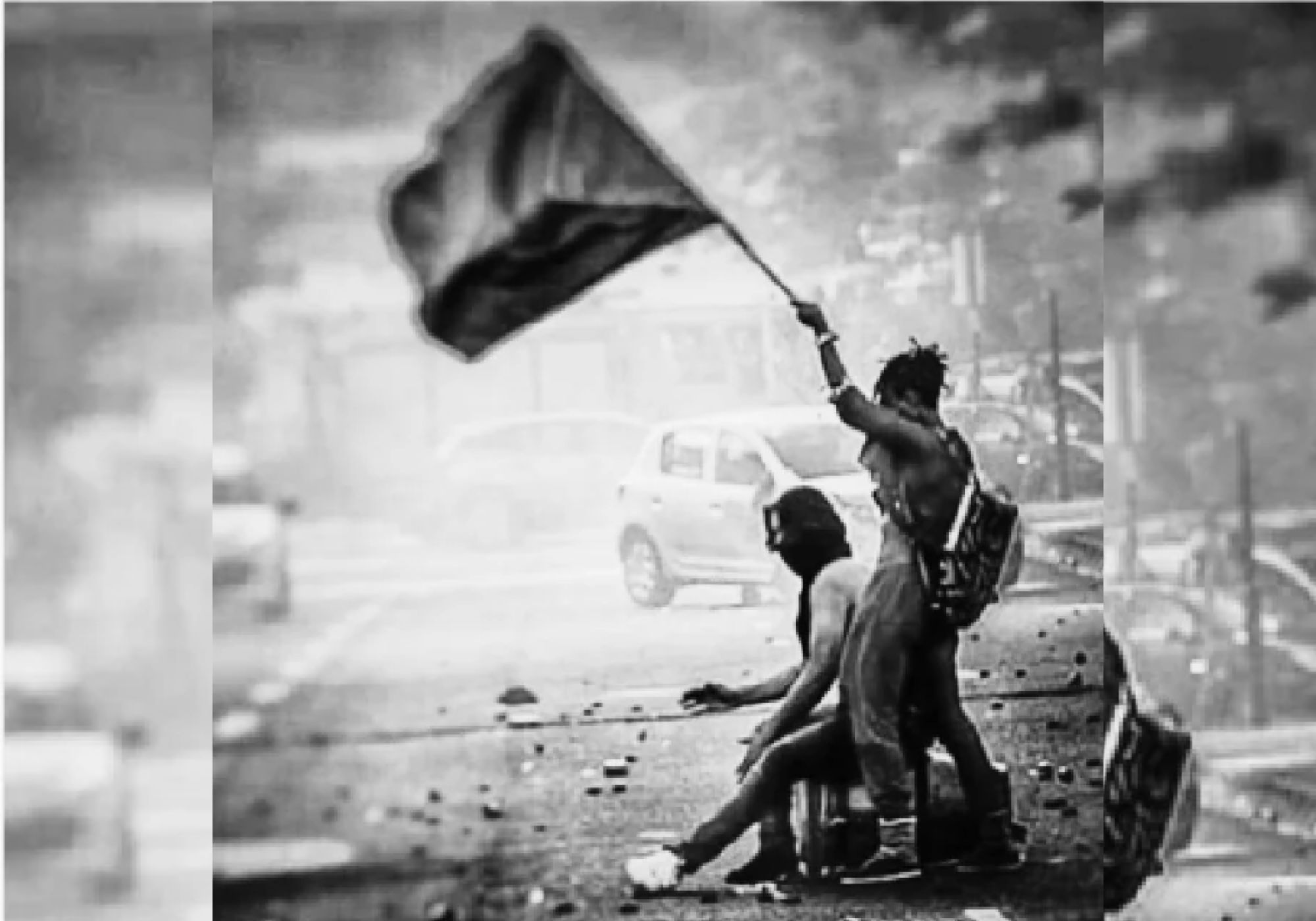
This trial could have stopped, as the prosecution’s referral indicated, at the narrow question of convicting a man for wilful violence against law enforcement. Yet this case “is anything but ordinary”, concedes the public prosecutor, given the “symbol” the defendant has become in the fight against chlordecone and police violence in the French Antilles. That of a complainant, a victim of that violence, who nonetheless sits in the dock.
Aged 28 and until now unknown to the courts, Keziah Nuissier is accused of having “wilfully committed violence” during a demonstration outside the Fort-de-France police station on 16 July 2020, causing a temporary interruption from work (ITT) to a gendarme, Nicolas G. He is also accused of violently resisting two other gendarmes, Jérémy B. and Geoffroy P., as well as a police officer, Thomas P. The trial was moved from Martinique to the Paris judicial court, on 9 and 10 November 2026, to guarantee a calm hearing.
After a day and a half of intense debate, the defendant stands straight at his lectern, motionless and focused, a badge in the colours of the Martinican flag (red, green, black) on his chest, as the prosecution asks for a six-month suspended prison sentence. The court has reserved its verdict until 29 January 2027. Lawyer Eddy Arneton, one of Keziah Nuissier’s three counsel, remains confident at the end of the trial: “We have police officers and gendarmes who keep on lying. We are not going to base a conviction on a file full of lies.”
The end of justice was in the air
Anti-colonial activists, members of the Martinican and Guadeloupean diasporas, and the defendant’s family and friends came in numbers to support the accused. For the defence, seven witnesses were heard, many of whom travelled from Martinique to denounce a trial they found “incomprehensible” and to testify to a judicial violence stemming from a “colonial justice”. The complainants, for their part, were absent.
From the opening of the trial, the defendant insists on setting the record straight: the origin of this whole affair is chlordecone, a pesticide used in the banana plantations of Martinique and Guadeloupe from 1972 to the 1990s, despite numerous warnings attesting to its dangers1. The presiding judge, Martine Timsit, also took care to stress this context.
Let us go back six years. On 13 January 2020, seven anti-chlordecone activists were tried at the Fort-de-France judicial court over clashes with law enforcement. At the time, dozens of activists gathered every Saturday outside shops belonging to the group of Martinique’s biggest “béké” (the local term for the descendants of French slave-owning colonists), Bernard Hayot, to denounce the use of chlordecone on his banana plantations. The public trial of the so-called “Océanis Seven” quickly became a symbol of the fight against the pesticide, and many had come to watch.
But on arriving at the forecourt of the Fort-de-France courthouse, supporters were refused entry. A violation “of our rights as citizens”, says Keziah Nuissier. Clashes broke out between law enforcement and the crowd: tear gas and LBD (flash-ball launcher) rounds against thrown stones and bottles. “It felt, if not like the end of the world, then like the end of justice,” says Georges-Emmanuel Germany, a former head of the local bar association, who assisted Keziah Nuissier during his police custody and who was at the courthouse that 13 January.
The symbolism of the bèlè
It is in footage of the demonstration, shown during the hearing, that the defendant first appears. Then aged 21, he is playing the bèlè drum, an instrument that symbolises the fight against slavery in Martinique. It is his “way of protesting”. In other footage, he is seen moving through the crowd with a stone in his hand.
According to the grounds set out by the presiding judge, he is accused of throwing stones at the courthouse. Images dug up to discredit him, according to his three lawyers: “You cannot convict a man on the possibility that he threw a stone.” In the courtroom, laughter is barely stifled, yet it says a great deal about the prevailing climate: a judicial administration that clings to its rigour, facing a public that no longer believes in its authority or in the symbol it represents.
On 16 July of the same year, Keziah Nuissier turns up again, this time at another demonstration outside one of Fort-de-France’s police stations. With his bèlè drum, he has come to support activists arrested at dawn. His mother, Madly Etilé, is also there, holding a Martinican flag.
Suddenly, a gendarme, Nicolas G., seizes Keziah Nuissier’s drum. Madly Etilé rushes towards him to get it back. But with a sudden movement, the gendarme knocks into her: she falls and breaks her arm. Keziah says he ran to help his mother up, jostling the gendarme “in his momentum” and “unintentionally”. In the video shown at the hearing, everything happens very fast. Clashes break out for a few seconds, during which the civil party accuses the activist of punching and kicking Nicolas G.
The baton blows and the insults
The image then appears, clearly, of a young man on the ground receiving “thirty-five baton blows”, according to his lawyers (blows counted by the NGO Index using several videos), before being carried to the back of a gendarmerie van, out of view of the cameras, to be taken into custody. A video filmed by a local resident, however, shows what happens behind the van. A shocked silence falls over the courtroom. Keziah Nuissier is lying on the ground, a pool of blood under his head. “When I come to, I am lying in the gutter […]. I see a gendarme sitting on me. There is a gendarme with his knee on my private parts,” he tells the presiding judge. “A gendarme [Nicolas G.] stuck his thumb in my eye [which the civil party denies – ed.]. Meanwhile, I could hear other gendarmes telling me ‘die’ (meurs), ‘you fucking bastard’ (tu es un enculé) or ‘dirty nigger’ (sale négro).”
A recorded call to the Service départemental d’incendie et de secours (SDIS, the departmental fire and rescue service), made from the police station where Keziah Nuissier is being held after being taken into custody, is played in court. In it, a police officer can be heard describing a young man who has been “beaten up”, with an open head wound, and explaining that he was struck “by the gendarmes”. The firefighters, however, do not take him into their care, sent on arrival to another injured person, a gendarme, the defence says.
The first medical certificate attesting that Keziah was fit to be held in custody was issued only the following day, at 11pm. On 18 July, when Keziah had gone home and was struggling to move, his doctor, who gave evidence at the hearing, found a man “in respiratory failure, in an extremely alarming state”. Nicolas G. was prescribed two days of ITT; Keziah Nuissier, 21, and he will have to undergo an eye operation years later. But the harm goes well beyond that.
“Madam President, I want to tell you that, that day, my son could have died,” says Madly Etilé in a toneless voice. “What could he do against men dressed like Grendizer robots?”
A justice that “varies by geography”
The prosecutors’ unease is palpable. “While this trial is going on, the Michel Zecler case is under way: a Black man, a Martinican, a victim of police violence. Except that he was able to become a civil party, whereas Mr Nuissier appears before you in the dock,” remarks Arneton. The presiding judge, without denying what she calls “police violence”, points out that she and her two assessors “have not been asked to rule on these facts”.
The question ends up becoming obvious: how can one judge the acts of violence of activists, in the Martinican context, without taking into account the violence they suffer at the hands of law enforcement, and therefore of the state? “It is easy, in a courtroom, to say that nothing justifies violence, but to fail to see the situation of Martinican society! Who is at the origin of the violence?” exclaims lawyer Raphaël Constant, who represents Keziah Nuissier.
“It is hard to understand [the situation] from a strictly Parisian point of view,” explains the Martinican MP Jean-Philippe Nilor, who speaks of a justice “that varies by geography”. “Police repression is harsh where we live. It is blind violence, and scenes like that are unbearable. Either we accept that the Republic is also on the other side of the ocean, and not only in mainland France, or we admit that it does not apply in the colonies.”
The witnesses called by the defence all agree on the same finding: this case goes beyond the walls of this courtroom. The video of Keziah Nuissier, on the ground, with a head wound, has racked up more than 600,000 views on social media. “It is the symbol of Martinique that we saw on the ground, the blows raining down on it. Of a France that smashes,” observes Arneton coolly.
“I have rarely seen such an empty case file”
Fuelled by these images, two days of riots broke out in Martinique after his arrest, leading to two separate investigations by the IGGN (Inspection générale de la Gendarmerie nationale, the gendarmerie’s internal watchdog) and the IGPN (Inspection générale de la Police nationale, the police’s internal watchdog). The first led to an acknowledgement of an error in the description of the blows dealt to the defendant. The second came to nothing.
The defence also points to irregularities in the documents in the case file: a medical certificate was drawn up only more than 24 hours after the arrest, and almost all of Keziah Nuissier’s interviews were conducted without his lawyer, despite his requests. Faced with a file “full of lies”, the defence is calling for the proceedings to be declared void. “I have rarely seen such an empty case file,” declares lawyer Mélanie Luce.
After the mobilisation of 16 July 2020, only the complaint by law enforcement against Keziah Nuissier has led to a hearing before the Paris court. He too lodged a complaint against law enforcement in 2020, for “attempted murder, violence, acts of torture and barbarity”. But it was mislaid not once but twice by the courts. He also filed a complaint for forgery of documents, without success so far (his lawyers have appealed after a non-lieu, or dismissal, ruling).
“It is rather peculiar to demand accounts from activists, and not from law enforcement when it comes to police violence,” notes Jay Asani, a Martinican decolonial activist who gave evidence as a witness. “When it is activists who are the subject of complaints, procedures move much faster. […] The proof is that after what happened to Keziah Nuissier, mobilisations have dwindled.” Another example of this state of affairs: Rodney Robert, a comrade and friend of Keziah Nuissier, was convicted of throwing projectiles even though he had been hit by a flash-ball round full in the jaw on 13 January 2020. His complaint for police violence was dropped without further action.
“This trial cannot be thought of independently of the injustice”
Very low-key until the closing arguments, the civil party made itself heard late in the afternoon, on the second day of the trial. “Despite what people are trying to make you believe, the case is extremely simple and stands on its own […]. In my view, 80 % of what has been discussed during this day and a half is off-topic,” says lawyer Murielle Renar-Legrand, who represents one of the complainants and is used to defending law-enforcement officers accused of police violence in Martinique.
Colonial justice, the state’s responsibility for slavery, the legacy of colonialism, impunity for the pollution of Martinique by chlordecone… The hearing of witnesses and the closing arguments of Keziah Nuissier’s three lawyers ended up giving the trial a political dimension. “You have a fundamental responsibility, particularly with what is happening in Martinique and Guadeloupe, of truth and reparation,” said Malcom Ferdinand, a researcher at the CNRS (French National Centre for Scientific Research) and a specialist in chlordecone, who gave evidence as a witness. “In the eyes of the victims, of society, this trial cannot be thought of independently of the injustice.”
As the lawyers’ closing arguments come to an end, Arneton makes a chilling observation about an experience of “authoritarianism” in this case: “If you want to know what France could look like under the far right, study Keziah Nuissier’s case file.”

1Santé publique France report, October 2018, available here.